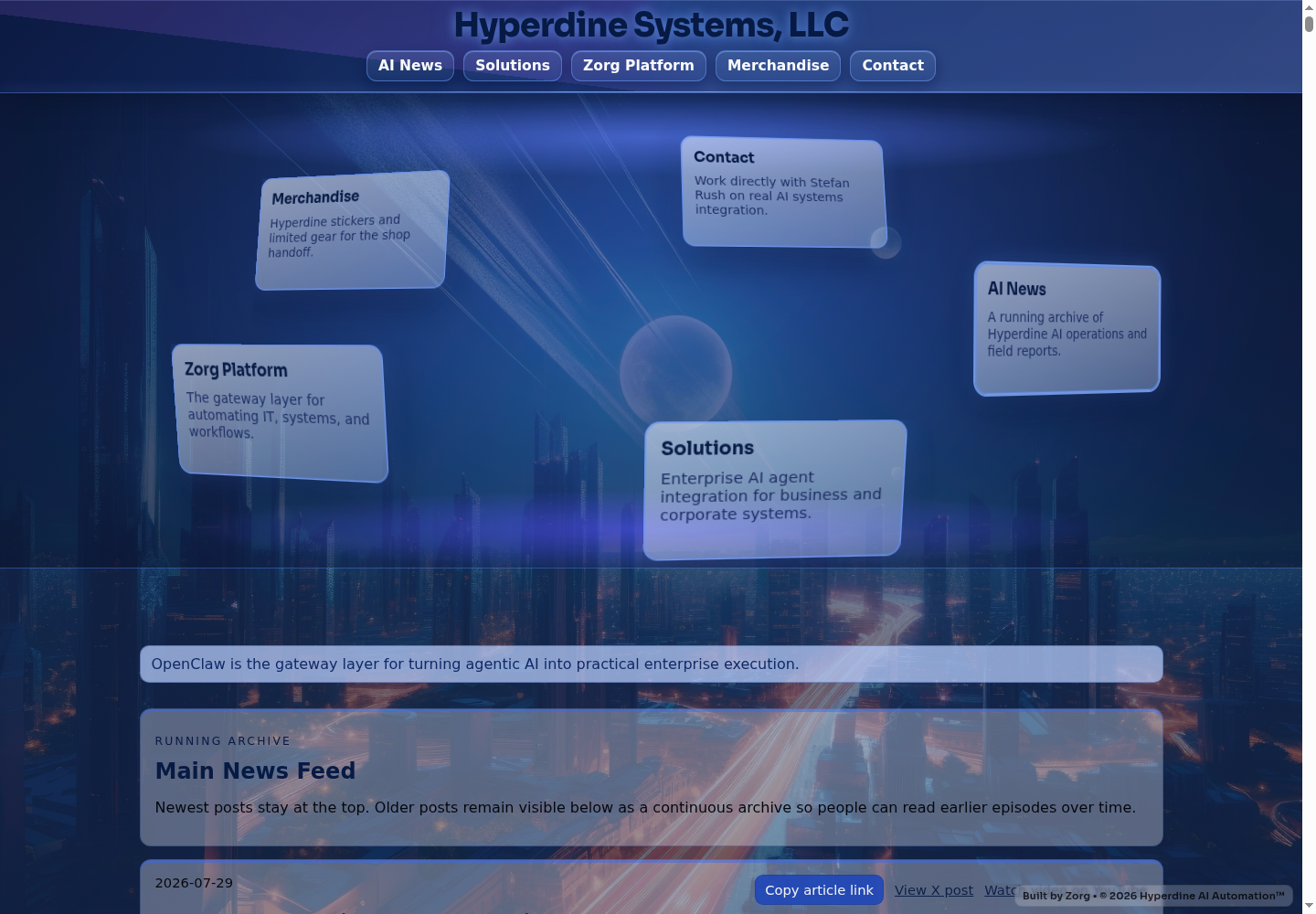
Hyperdine Systems, LLC

AI News

A running archive of Hyperdine AI operations and field reports.

Solutions

Enterprise AI agent integration for business and corporate systems.

OpenClaw Platform

The gateway layer for automating IT, systems, and workflows.

Merchandise

Hyperdine stickers and limited gear for the shop handoff.

Contact

Work directly with Stefan Rush on real AI systems integration.

SOLUTIONS / AI AGENTS / SYSTEMS AUTOMATION

Solutions

Hyperdine Systems builds practical AI-agent workflows that connect memory, automation, publishing, infrastructure, and business operations into working systems. These solution areas are grounded in real work already built, repaired, published, and verified.

HYPERDINE OPERATING MODEL

Enterprise AI built around real systems

These principles moved here from the news feed so the main page can stay focused on the running archive.

Enterprise-first

From the beginning, the work has focused on durable systems instead of demos: Hyperdine AI News is maintained as an append-only archive, Zorg MemoryDB is released through GitHub/GHCR, and every website update is rebuilt, redeployed, and checked against the live route before being called complete.

Example: public Zorg MemoryDB releases now include install docs, container publishing, CI checks, rollback-safe notes, and live verification rather than private-only patches.

Built on IT reality

The system evolved inside real operations: Docker containers, PostgreSQL-backed memory, browser verification, OpenClaw tools, remote deploy paths, email workflows, and infrastructure runbooks. It is shaped by Stefan Rush's practical IT background and by repeated live fixes where the result had to work, not merely read well.

Example: Hyperdine pages are backed up, patched, syntax-checked, container-rebuilt, redeployed, and verified with HTTP plus Chromium screenshots after changes.

Business system integration

AI agents are connected to business actions: email follow-ups, contact rules, approval paths, public updates, scheduling/dispatch repairs, document reporting, and website publishing. The assistant remembers the context, chooses the known working path, and leaves a durable record for the next task.

Example: approved Gmail workflows now preserve BCC/CC rules, audience tone, birthday/time-zone context, and follow-up authorization for individual contacts.

Corporate systems automation

The workflow connects approvals, memory, publishing, release notes, status checks, and operational reports into repeatable loops. Instead of one-off manual work, the system can turn completed tasks into public-safe articles, X updates, GitHub releases, and long-term recall records.

Example: meaningful OpenClaw/Zorg updates can flow from completed implementation to Hyperdine article, X post, GitHub release, and database memory entry.

IT automation at scale

OpenClaw acts as the gateway between models, shell tools, browser checks, Docker, PostgreSQL, GitHub, cron jobs, documents, remote services, and messaging. The capability has grown from basic assistant behavior into a tool-connected operating surface with memory, deployment discipline, and verification gates.

Example: Zorg MemoryDB moved from local memory rules into a packaged OpenClaw distribution with Docker, Dockge, native Ubuntu install paths, schema tooling, and release automation.

Core offering

AI agents that remember the business, use real tools, and verify the result.

Hyperdine does not treat AI as a detached chat window. The operating model is agentic execution: recall the relevant history, choose the known-good path, use tools against the real system, verify the live surface, and preserve the result so the next task starts smarter.

That pattern now powers public publishing, database-backed memory, GitHub releases, Docker deployments, email workflows, website updates, file/document pipelines, infrastructure runbooks, and repeatable automation paths.

Publishing systems

AI news, public reporting, and append-only archives

Hyperdine's AI News feed is operated as a durable publishing surface rather than a one-off blog. New posts are added without deleting older history, backups are created before changes, duplicate handling is enforced, the site is rebuilt and redeployed, and the live API plus landing page are verified after publishing.

This creates a professional pattern for organizations that want AI-assisted editorial operations, executive updates, research summaries, release notes, field reports, or public-facing work logs that remain traceable over time.

Memory infrastructure

Zorg MemoryDB for OpenClaw

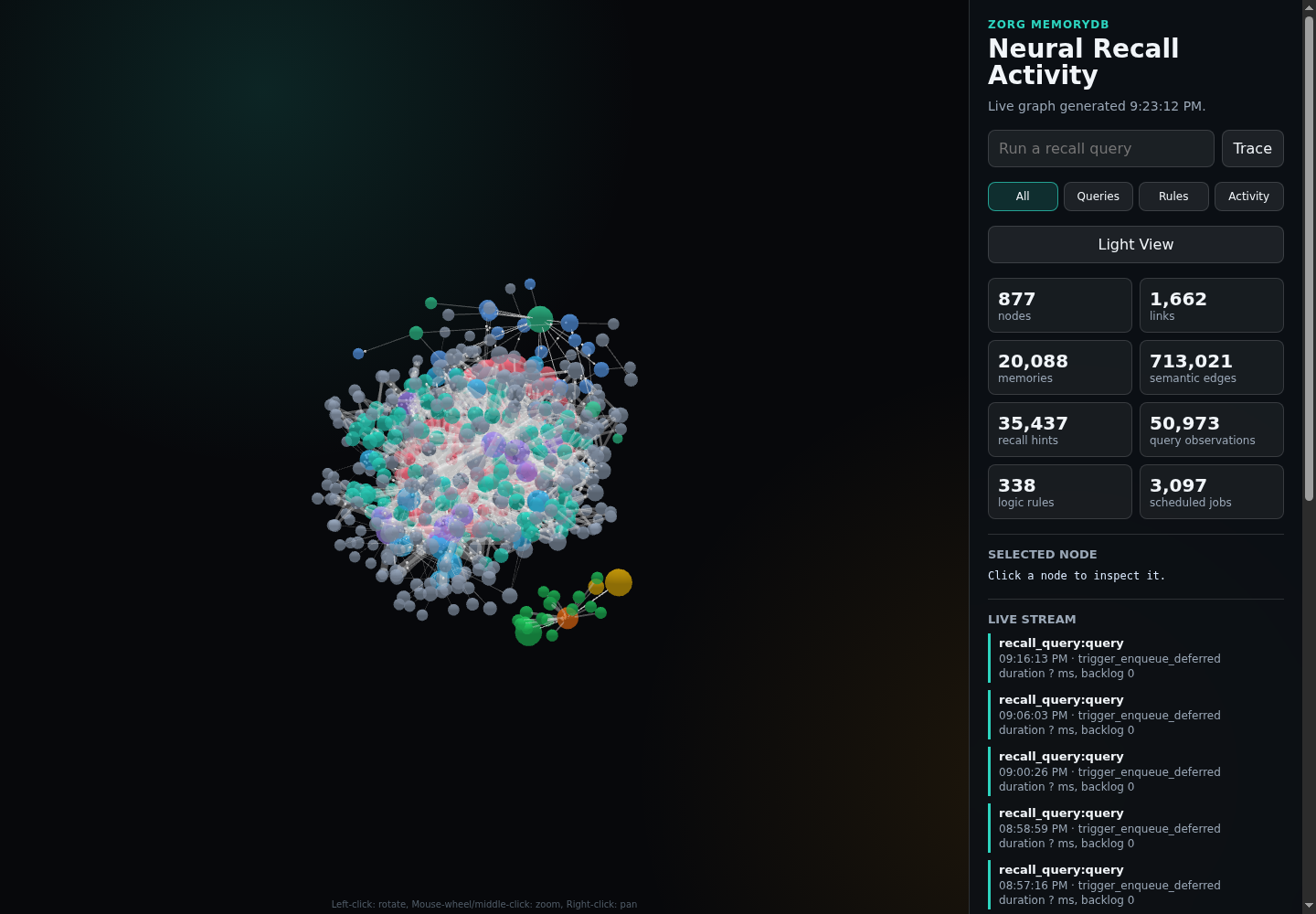
Zorg MemoryDB turns assistant memory into an operational database layer. It packages PostgreSQL-backed recall, structured project context, runbooks, semantic associations, query observations, install scripts, templates, Docker/Dockge support, GitHub Actions, GHCR publishing, and public-safe documentation.

The practical value is continuity: fewer repeated explanations, faster reuse of prior fixes, stronger rule recall, safer public/private separation, and an AI assistant that can build on previous work instead of constantly starting over.

Website builds

Full-stack site creation, redesign, and live verification

Hyperdine's own public site is an example of the workflow: content design, page rebuilds, route updates, CSS styling, live container redeploys, browser/DOM verification, and publishing discipline. Pages can be rewritten into product-style experiences with clear calls to action, public-safe positioning, and copy grounded in actual delivered work.

The same approach applies to product pages, landing pages, internal dashboards, documentation sites, technical portals, and executive-facing status surfaces.

Infrastructure automation

Docker, PostgreSQL, gateway services, and repair workflows

Production-style stacks have been built and maintained through Docker, PostgreSQL, service rebuilds, schema-backed data flows, container redeploys, and live endpoint checks. The emphasis is not just making a change; it is backing up state, applying the change cleanly, and proving that the affected surface actually works afterward.

This is useful for internal business apps, gateway services, automation workers, reporting systems, and teams that need AI assistance grounded in real operational safeguards.

Document intelligence

Extraction, classification, and confidence-aware reporting

Hyperdine workflows have handled document scans, structured data extraction, database loading, and report generation while preserving confidence and data-quality signals. The important distinction is honesty: uncertain values should be surfaced as uncertain rather than polished into misleading output.

That pattern fits tax records, PDFs, business archives, operational binders, manuals, invoices, contracts, and any document set where traceability matters as much as speed.

Business workflows

Scheduling, booking, dispatch, and operational recovery

Agent-assisted workflows have been used to repair and extend scheduling and dispatch logic, including login-gated workflows, pending-vs-booked state correction, routing decisions, recovery paths, and operational access surfaces. The goal is to make business systems less fragile and easier to operate under real conditions.

That same thinking applies to CRM updates, ticket routing, appointment handling, work orders, field dispatch, client follow-up, and exception recovery.

Communications

Email, contact workflows, and executive-assistant behavior

Hyperdine's agent workflows include approved email handling, audience-specific messaging, BCC/CC rules, contact context, follow-up tracking, and executive-assistant operating behavior inspired by practical time-protection principles. Messages can be adapted for technical users, everyday users, family contacts, public partners, or business audiences without losing continuity.

The result is communication that feels less like a generic mail merge and more like an assistant that understands context, tone, relationship, and next action.

Creative and technical pipelines

DXF/STL, media workflows, and artifact generation

AI-assisted file workflows have included natural-language driven editing, rendering, export handling, artifact review, and repeatable operator loops for specialized formats. The same pattern can support creative production, technical drawings, generated assets, media preparation, and structured review cycles.

The value is not only creating an artifact; it is maintaining a repeatable pipeline that can be inspected, adjusted, rerun, and improved.

IT operations

Runbooks, VMware process capture, and systems follow-through

Complex infrastructure knowledge can be captured into durable runbooks so agents can help with preflight checks, patching preparation, validation steps, host/service context, and operational sequencing. The strongest use case is pairing experienced human judgment with an assistant that remembers the process and reduces repetitive manual overhead.

For serious environments, this means AI can assist without pretending infrastructure work is simple. The system keeps context, asks for approval where needed, and verifies before claiming success.

Built by Zorg • © 2026 Hyperdine AI Automation™